


Departure Date: September 20 - October 6, 2025
Compiled By: Max Breckenridge
Trip Leaders: Max Breckenridge, Scott Baker
Toll Free: 800.328.8368
Phone: 512.328.5221



Grand Australia Part I 9/20/2025-10/6/2025

Grand Australia Part I
https://ebird.org/tripreport/414904
This year’s Grand Australia Part One tour proved to be another fulfilling adventure in the great company of ten eager travelers and my good friend, co-leader, and expert bus driver Scott Baker.
After assembling at our hotel next to Hyde Park in downtown Sydney, our first official outing took us to the nearby Centennial Park. Here we familiarized ourselves with many of the commoner species in this part of the country, plus several notables like Tawny Frogmouth, Buff-banded Rail, Hardhead, Olive-backed Oriole, and of course, the lovely Superb Fairywren. We also had excellent studies of some of the hundreds of flying-foxes that roost here, with two species represented—Black and Gray-headed.
Our day in the Royal National Park south of Sydney was a real treat, with perfect weather (if a little cool to start), no crowds of people, and a great selection of birds that had read the memo. Along Lady Carrington Drive (an old convict road that follows the edge of the Hacking River) the birds came thick and fast, as is often the case on our first day in proper forest. Green Catbird showed up; Variegated Fairywrens elicited gasps; Australian Rufous Fantail and Black-faced Monarch were recently returned; three species of scrubwrend were compared; a surprise Rockwarbler was a great find; and the much-desired Superb Lyrebird scratched around atop a sandstone boulder right beside the trail. After a great lunch at Audley (complete with Sulphur-crested Cockatoos at our table), we headed to the coastal heaths and dramatic cliff-faces at Wattamolla. The pick of the birds was a remarkably confiding Chestnut-rumped Heathwren, but the Short-beaked Echidna beside the track stole the show.
_1000.jpeg)
Antipodean Albatross from our Sydney Pelagic (C) Scott Baker
The wide blue beckoned the next day, with forecasted perfect conditions proving true—sometimes a rare occurrence in early Spring. My good friend (and seabird expert) Simon Gorta joined us for the pelagic and, alongside skipper Adam, made it a great day. Seabird diversity was slightly above average, with particularly good numbers of albatross, many of which sat happily behind the boat, including two magnificent Antipodean Albatross. On the way back into port, we enjoyed a couple of Humpback Whales on their migration south, plus two species of fur seals (New Zealand and Australian) on the rocks near South Head.
It was time to leave Sydney for greener pastures and more birds, but not before a morning walk in Lane Cove National Park, where we struck gold with a roosting trio of formidable Powerful Owls, plus the much-less terrifying Australian Brushturkey strutting around a suburban park in nearby Epping. In the Blue Mountains, west of Sydney, we struggled to find a Glossy Black-Cockatoo in the now blustery conditions but were consoled somewhat by a brief sighting of the uncommon Beautiful Firetail. Heading further west, we spent the late afternoon around the shores of Lake Wallace. Here we located several species of ducks, including the strange Musk Duck, plus a good assortment of bush birds and parrots.
The next morning was spent exploring the renowned Capertee Valley. This is undoubtedly the best place close to Sydney to encounter a wide variety of woodland species typical of inland southeastern Australia. We weathered a real barrage of honeyeaters, but alas this year the Regent Honeyeaters had decided to go elsewhere; instead we made up for it with glorious looks at the declining Hooded Robin, stunning Diamond Firetail, cute Dusky Woodswallows, Jacky-winter, White-browed Babblers, Pallid Cuckoo, gorgeous Eastern Shrike-tit, and strange White-winged Choughs. The morning was capped off by another fantastic lunch, eating home-cooked food and drinking great coffee at an excellent little establishment with panoramic views of the steep sandstone cliffs that tower over the valley.
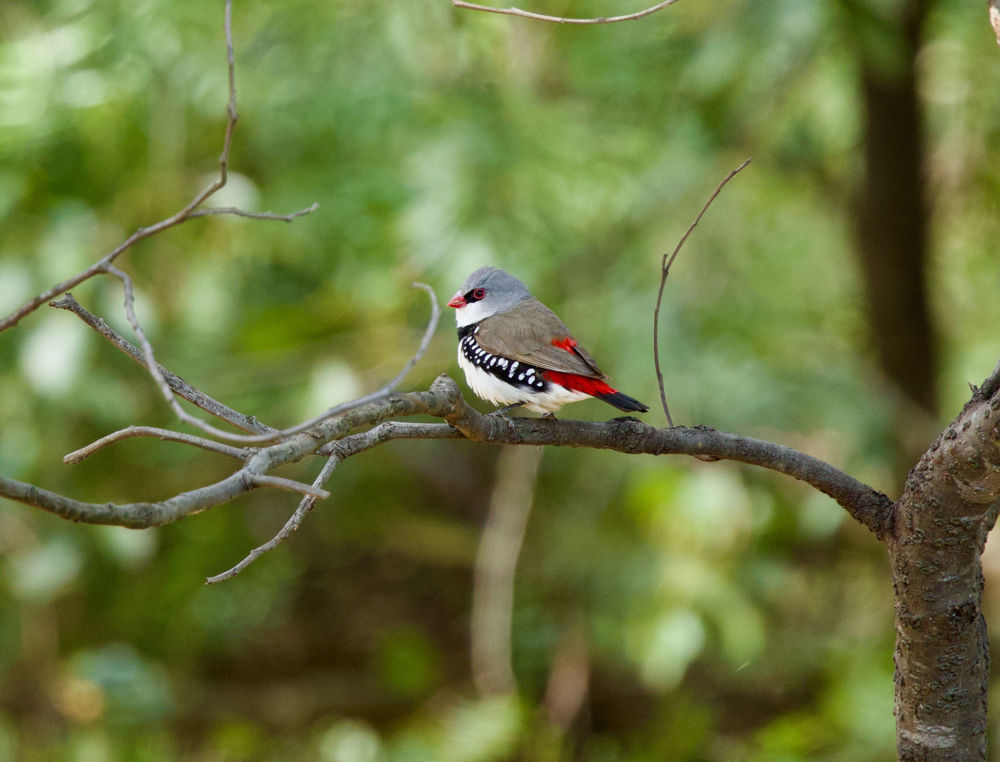
Diamond Firetail from the Capertee Valley (C) Scott Baker
The next day we arrived in the tropics and began our exploration of the Darwin area and “Top End” of the Northern Territory. The highlight of our first afternoon around town was undoubtedly a daytime pair of Barking Owls showing off at close range, along with Rose-crowned Fruit-Dove, Green-backed Gerygone, Little Bronze-Cuckoo, several new species of honeyeaters, Yellow Oriole, Varied Triller, and Northern Fantail.
The next day was action-packed from the outset, with an early morning start at a new site south of Darwin, where we quickly locked onto a flock of everyone’s most-wanted Gouldian Finches. We had a great session here, where a small puddle beside a dirt road was attracting a great variety of birds for a morning drink. Howard Springs was next, and Rainbow Pitta eventually behaved for us with great views of one hopping along the track in front of us. A daytime Arafura File Snake near the springs was a surprise, and we also enjoyed good looks at Arafura Fantail, Broad-billed Flycatcher, and Large-billed Gerygone. In the afternoon, a visit to the mangroves proved to be a pleasant outing, with Red-headed Honeyeater and Yellow White-eyes the pick of the birds.
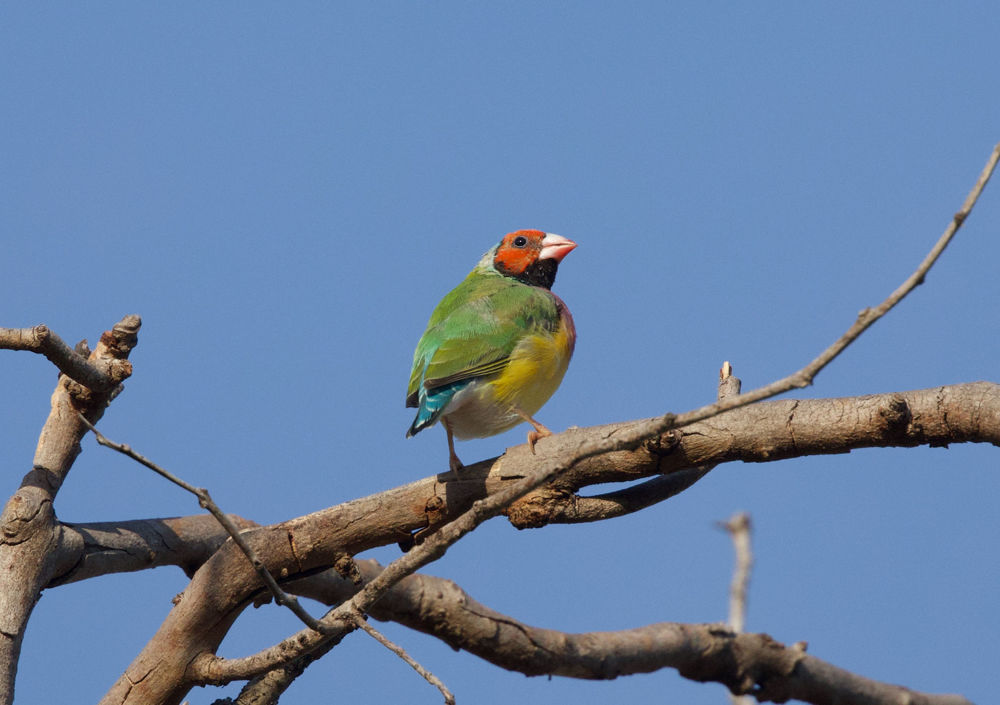
Gouldian Finch from Darwin River (C) Scott Baker
The following morning we had a productive session at Buffalo Creek before driving west towards Kakadu. Along the way we stopped in at Fogg Dam, where the birding was very good in the monsoon forest (nesting Rose-crowned Fruit-Dove and several vocal Sahul Brush Cuckoos), and out along the dam wall White-browed Crake behaved beautifully, along with Paperbark Flycatchers and Comb-crested Jacana. We capped off another great day with excellent roadside views of good numbers of the declining Partridge Pigeon near Cooinda.
Our full day in Kakadu NP started with a glorious morning boat trip out on the stunning Yellow Waters billabong. As always, it is a very birdy and enjoyable outing, with plenty of impressive Saltwater Crocodiles seen, along with large numbers of waterbirds. Hundreds of Magpie Geese commuted overhead, mixed flocks of whistling-ducks were seen at close range, a confiding Little Kingfisher was a fortunate sighting, and baby Comb-crested Jacanas were seen getting to grips with their remarkably long toes. After our midday siesta, we ventured out to Ubirr in the northeast of the park, where the hoped-for Chestnut-quilled Rock-Pigeons were spotted before exiting the bus! As we were enjoying some of the breathtaking rock art found here, another of our targets appeared under the rock overhang—Sandstone Shrikethrush. Back in the carpark, the rock-pigeons had been replaced by a stunning Pacific Emerald Dove. That evening, a couple of us ventured out spotlighting and were rewarded with more great views of Barking Owls, plus a cute Australian Owlet-Nightjar.
Before departing Kakadu, we visited one last site—Nourlangie. Here, under the towering sandstone escarpment, we nabbed our last two sandstone specialties, with good looks at Black-banded Fruit-Dove and White-lined Honeyeater. On the road again, we made it to Pine Creek for lunch, where the usual Hooded Parrots were found right outside the gas station, along with our first impressive Great Bowerbird bower and its owner.
Without the long, pre-dawn drive to Victoria River this year, we spent a full day in the Katherine area, which proved highly successful. An hour’s drive out of town and down a dusty, corrugated track, we pulled up and had the rare Northern Shrike-tit calling before we were all off the bus! We quickly tracked it down and enjoyed great looks at this very scarce and poorly known inhabitant of good quality savanna woodlands. It turned out to be a very birdy locale, with highlights being the golden-backed form of Black-chinned Honeyeater, black-capped Varied Sittellas, more Hooded Parrots, Cockatiel, White-winged Triller, and several Antilopine Kangaroos. In the afternoon, we visited Nitmiluk NP, just outside of town, and had excellent views of bathing Northern Rosella.
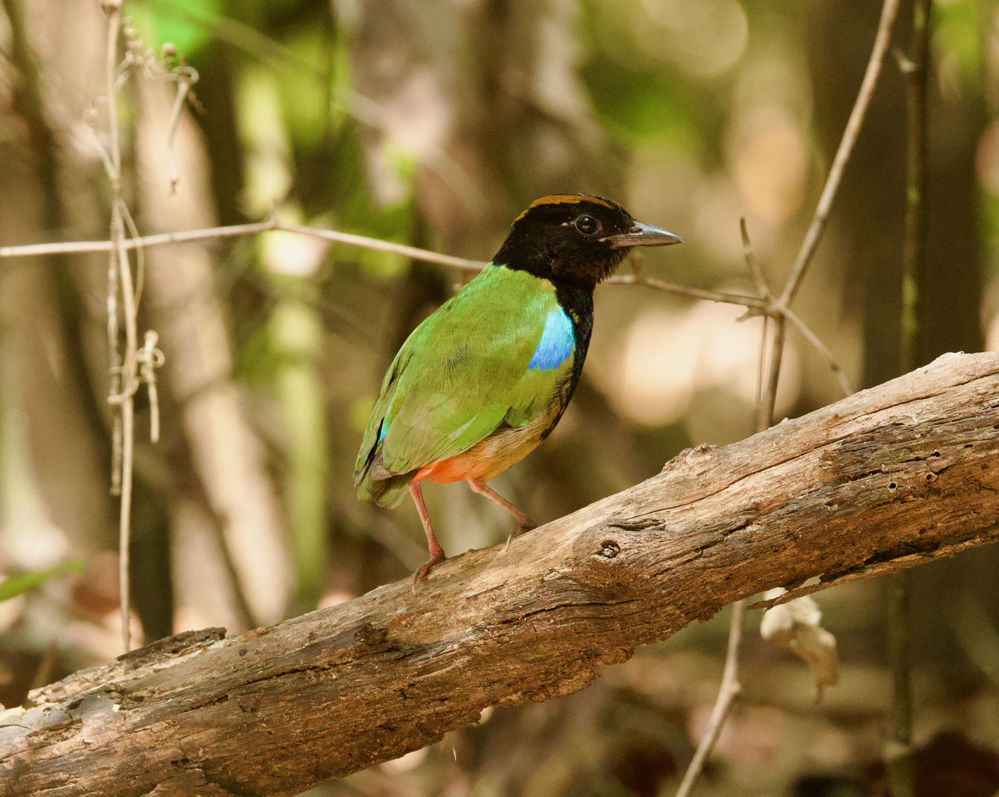
Rainbow Pitta from Howard Springs NR (C) Scott Baker
We had a fairly cruisy day before our afternoon flight from Darwin to Alice Springs. Leaving Katherine, we stopped in along the road to Edith Falls, where a couple of waterhole visits were highlighted by nice looks at a pair of Long-tailed Finches. A final surprise of our time in the Top End was a flock of Oriental Plovers beside the runway.
Our time in the Red Centre was a great bookend to what had been a fantastic trip. Our local guide and driver, Sophie, ensured we had a great time, from the West MacDonnell Ranges and Santa Theresa Road all the way down to Yulara and Uluru. Better than average conditions around Alice Springs this year meant the birds were active, with several small flocks of Budgerigars much appreciated, as well as a couple of Crimson Chats—both nomadic species of the Australian interior that seek out areas of recent rain. Red-browed Pardalote near Simpson’s Gap, Painted Firetails drinking at Serpentine Gorge, abundant Spinifex Pigeons at Ormiston Gorge, and a confiding trio of scarce White-browed Treecreepers along the Santa Theresa Road were some of the many highlights.
At Yulara we soaked up our time around Uluru, complete with champagne and canapes at sunset, and even managed to get Scott his lifer Sandhill Grasswren—with uncharacteristically good views for the whole group! We certainly crammed in a lot of great experiences on this trip, and there were fond farewells as our group split—all of us bound for new parts of Australia.
_1000.jpeg)
Western Bowerbird from Alice Springs (C) Scott Baker
A complete list of the birds recorded on our tour can be found at: https://ebird.org/tripreport/414904
Description for the next departure of this tour.
Max Breckenridge's upcoming tour schedule.
Scott Baker's upcoming tour schedule.
ITINERARY:
Day 1: September 22, 2025: (AM) Sydney; (PM) Centennial Park
Day 2: September 23, 2025: (AM) Royal NP - Lady Carrington Drive, Audley, (PM) Wattamolla; Burraneer Park
Day 3: September 24, 2025: (AM)/(PM) Sydney Pelagic
Day 4: September 25, 2025: (AM) Lane Cove NP - Terry's Creek; Epping; (PM) King's Tableland, Eaglehawk Lookout, Lake Wallace
Day 5: September 26, 2025: (AM) Capertee Valley - Glen Davis, Glen Alice, (PM) Upper Nile; Sydney
Day 6: September 27, 2025: (AM) SYD-DRW; (PM) Darwin - George Brown Botanic Gardens
Day 7: September 28, 2025: (AM) Darwin River, Howard Springs NR, Knuckey's Lagoon; (PM) Coconut Grove
Day 8: September 29, 2025: (AM) Buffalo Creek, Fogg Dam; (PM) Kakadu NP - Bowali, Cooinda
Day 9: September 30, 2025: (AM) Kakadu NP - Yellow Waters, Cooinda, (PM) Jabiru, Ubirr
Day 10: October 1, 2025: (AM) Kakadu NP - Nourlangie, Gerowie Creek; (PM) Pine Creek, Katherine
Day 11: October 2, 2025: (AM) Gorrie River Rd, Katherine STW; (PM) Katherine, Nitmiluk NP - Katherine Gorge
Day 12: October 3, 2025: (AM) Edith Falls Rd; (PM) Knuckey's Lagoon, George Brown Botanic Gardens, DRW-ASP
Day 13: October 4, 2025: (AM) West MacDonnell NP - Simpson's Gap, Ellery Creek, Ormiston Gorge, (PM) Serpentine Gorge
Day 14: October 5, 2025: (AM) Santa Theresa Rd, Erldunda; (PM) Yulara, Uluru
Day 15: October 6, 2025: (AM) Yulara, Uluru; (PM) AYQ-
 Honeyeater_1000.jpeg)
Black-chinned (Golden-backed) Honeyeater from the Katherine area (C) Scott Baker
MAMMALS:
BALAENOPTERIDAE (Rorquals)
Humpback Whale (Megaptera novaeangliae) - Distant breaching individuals and blowing observed from the cliffs at Wattamolla in the Royal NP. Also seen on our Sydney Pelagic.
TACHYGLOSSIDAE (Echidnas)
Short-beaked Echidna (Tachyglossus aculeatus) - Excellent looks at an adult beside the track at Wattamolla in the Royal NP.
MACROPODIDAE (Macropods)
Wallaroo or Euro (Macropus robustus) - Singles observed on hillside opposite our hotel in Alice Springs.
Black Wallaroo (Macropus bernardus) - A single seen briefly at Nourlangie Rock in Kakadu NP.
Red-necked Wallaby (Macropus rufogriseus) - At least two individuals observed in the Capertee Valley.
Eastern Gray Kangaroo (Macropus giganteus) - Tens observed around Wallerawang and in the Capertee Valley.
Antilopine Kangaroo (Macropus antilopinus) - Up to 10 individuals observed on our morning west of Katherine.
Agile Wallaby (Macropus agilis) - Singles/tens observed each day in the Top End.
Black-flanked Rock-wallaby (Petrogale lateralis) - Singles observed on rocky hillside opposite our hotel in Alice Springs. Also at Simpson's Gap in the West MacDonnell NP.
Swamp Wallaby (Wallabia bicolor) - Singles seen briefly in the Blue Mountains and Capertee Valley.
PTEROPODIDAE (Flying Foxes / Fruit Bats)
Black Flying-fox (Pteropus alecto) - Tens observed at a colony in Centennial Park. Seen frequently throughout the Top End.
Gray-headed Flying-fox (Pteropus poliocephalus) - Tens observed at a colony in Centennial park.
MURIDAE (Mice, Rats & relatives)
Rakali (Hydromys chrysogaster) - A single of this aquatic native rodent seen briefly at Lake Wallace.
OTARIIDAE (Eared Seals)
Long-nosed Fur Seal (Arctocephalus forsteri) - Singles observed below the cliffs near South Head on the Sydney Pelagic.
Brown Fur Seal (Arctocephalus pusillus) - Singles observed below the cliffs near South Head on the Sydney Pelagic.
EQUIDAE (Horses & Donkeys)
Brumby (I) (Equus ferus caballus)
Donkey (I) (Equus africanus asinus)
BOVIDAE (Goats, Cows & relatives)
Goat (I) (Capra hircus)
Asian Water Buffalo (I) (Bubalus bubalis)
LEPORIDAE (Rabbits & Hares)
European Rabbit (I) (Oryctolagus cuniculus)
European Hare (I) (Lepus europeanus)
REPTILES:
Saltwater Crocodile
Eastern Shortneck Turtle
Yellow-eared Turtle
Lace Monitor
Merten's Water Monitor
Frilled Dragon
Eastern Bearded Dragon
Inland Bearded Dragon
Jacky Dragon
Gilbert's Dragon
Eastern Water Dragon
Eastern Water Skink
White's Skink
Burton's Legless Lizard
Arafura File Snake
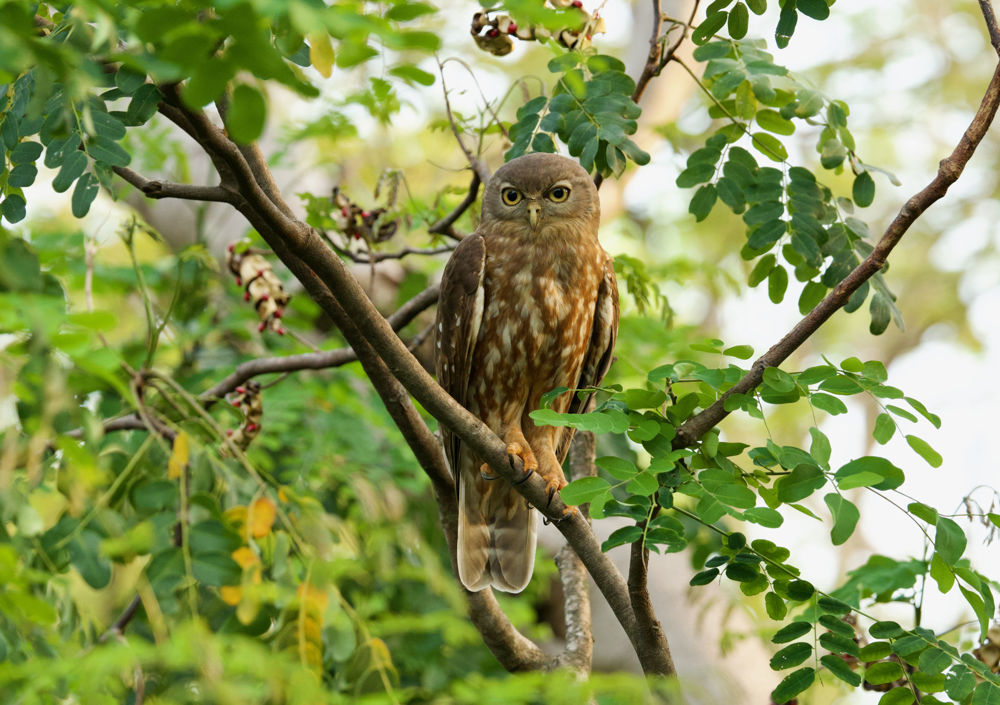
Barking Owl from Darwin (C) Scott Baker

