


Departure Date: March 10 - 25, 2025
Compiled By: Brian Gibbons
Trip Leaders: Brian Gibbons, Santiago Villa
Toll Free: 800.328.8368
Phone: 512.328.5221



Morocco 3/10/2025-3/25/2025

Morocco
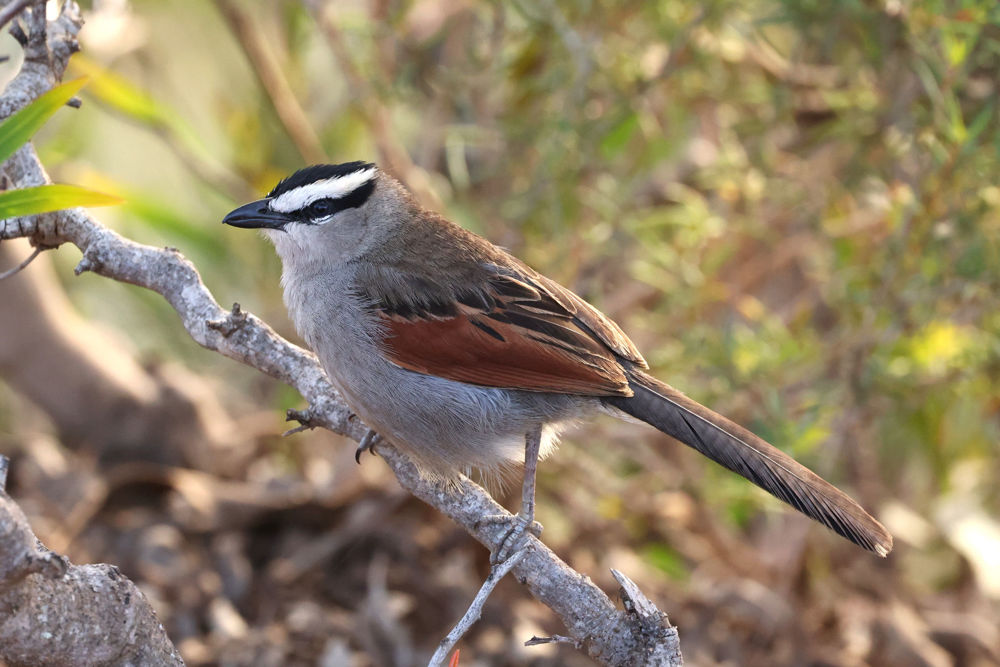
Black-crowned Tchagra at Souss Massa National Park
Soaring snowy mountain vistas, stony deserts, gorges, wadis, Atlantic estuaries, and a sandstorm in the Sahara gave us the full North African experience in Morocco. In Marrakech we experienced the alleyways of the souks and the pulse of life therein. The recent and ongoing rains allowed us to see the desert “green” and even a few oases filled with water with attendant birdlife that had been absent for seven dry years. Along the Atlantic coast the Souss and Massa Rivers held migrant shorebirds and waterbirds and the marquee bird for the region, Northern Bald Ibis. We drove more than 1,000 miles through spectacular terrain that hid birds and other wildlife until we scoured the landscape, revealing treasures like four species of sandgrouse, Lanner and (Barbary) Peregrine falcons, owls, and more larks and wheatears than you could imagine.
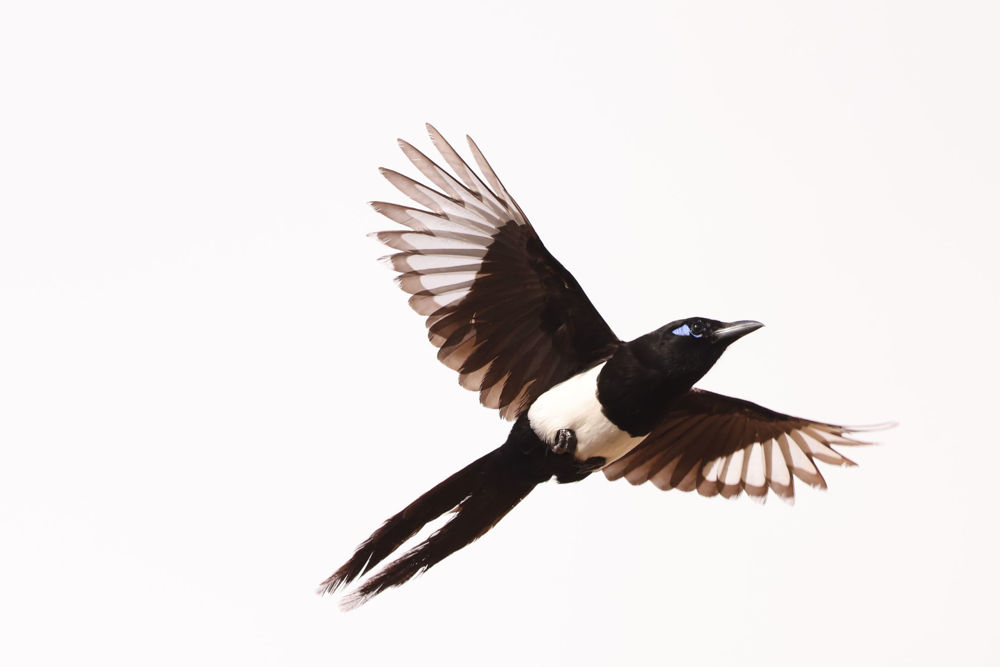
Maghreb Magpie, one of the first specialties of the tour
We started in Marrakech and wound around town for a little while, scanning the parks and greenways for our first North African endemic, the Maghreb Magpie, which Ossama spotted. That bird freed us up to head down to the coast at Agadir, where we would spend the next three days discovering new birds and wonderful food at the Riad Villa Blanche. On our first evening we birded the Souss River. We discovered Greater Flamingos, Slender-billed and Mediterranean gulls, shorebirds, and more magpies. We quickly learned to look forward to the evening meals that were equally gorgeous and delicious. South from Agadir we birded the Massa River as we worked our way to the Souss Massa National Park. Moussier’s Redstart, a handsome bird, slowed us down on our way to the river. Wandering along the river we scoured for Black-crowned Tchagra but never found one here. But we did enjoy a Zitting Cisticola gathering nesting material. Plain Martins were cruising above the river giving photographers fits, and a singing Iberian race of the Yellow Wagtail was more confiding.
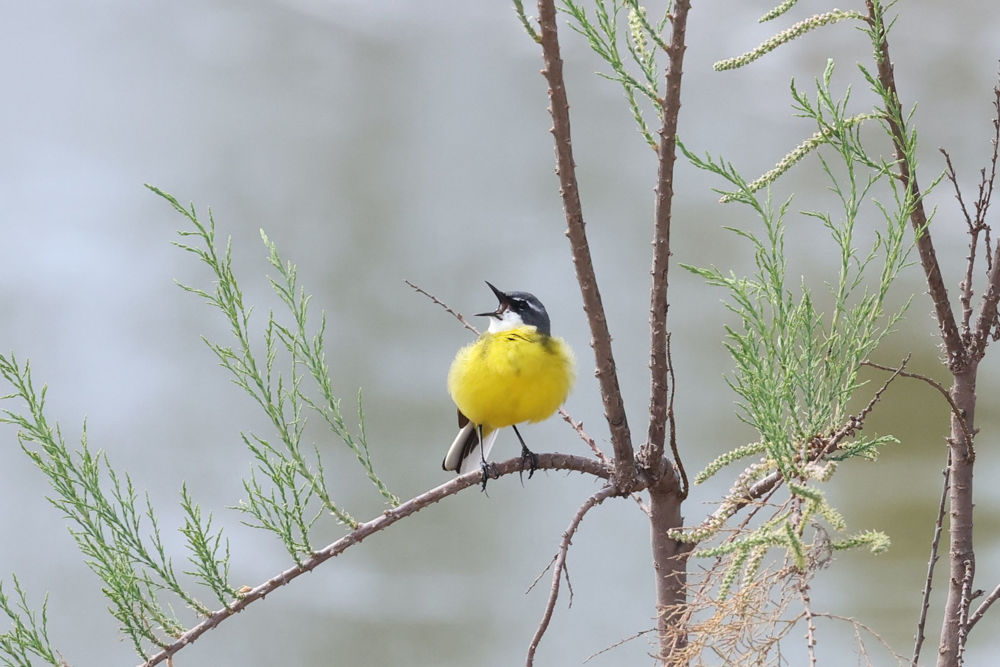
Western Yellow Wagtail
We found Sardinian and Western Subalpine warblers in the tamarisks on our walk and were serenaded by the bubbly calls of Common Bulbuls—but no Tchagra. We moved out to the coast at the little village of Sidi Wassay, where we found our first Northern Bald Ibis on sandy dunes above the surf. Loafing alongside were our first silvery Audouin’s Gulls. A barbed wire fence along the way saw the demise of a lizard at the bill of a Great Gray Shrike. We also logged the common Yellow-legged and Lesser Black-backed gulls. After a wonderful tajine lunch in a local restaurant we continued birding in Souss Massa National Park, where we finally connected with a few Black-crowned Tchagras and a very lost pair of Blue-winged Teal. Overhead, an Osprey labored with a backwards facing fish and a harassing Eurasian Kestrel. After a productive afternoon we headed back to Agadir and another excellent meal. After hearing Eurasian Thick-knees calling for a couple of nights, we stopped to scan a vacant field behind the hotel in the morning; in short order Santi had one spotted, then another, and another. Our final tally was at least thirteen. As we worked our way north along the Atlantic coast, we found a few new birds, some wonderful cliffside scenery, and a rainbow. Whimbrel on the beach and some Northern Gannets offshore were some of the birds we tallied. A walk through the dunes to get closer to a Bald Ibis colony produced our best sighting for the entire trip of a singing Western Black-eared Wheatear. We also had great studies of the Bald Ibis, especially as they flew right over our heads. We even witnessed them flying to their seaside cliff nesting sites with sticks. In the evening, we returned to Souss River to enjoy the evening light after a brief rain shower. Eurasian Spoonbills and Greater Flamingos were numerous along the river while Black-winged Stilts and Common Greenshanks made a racket as they were flying around.
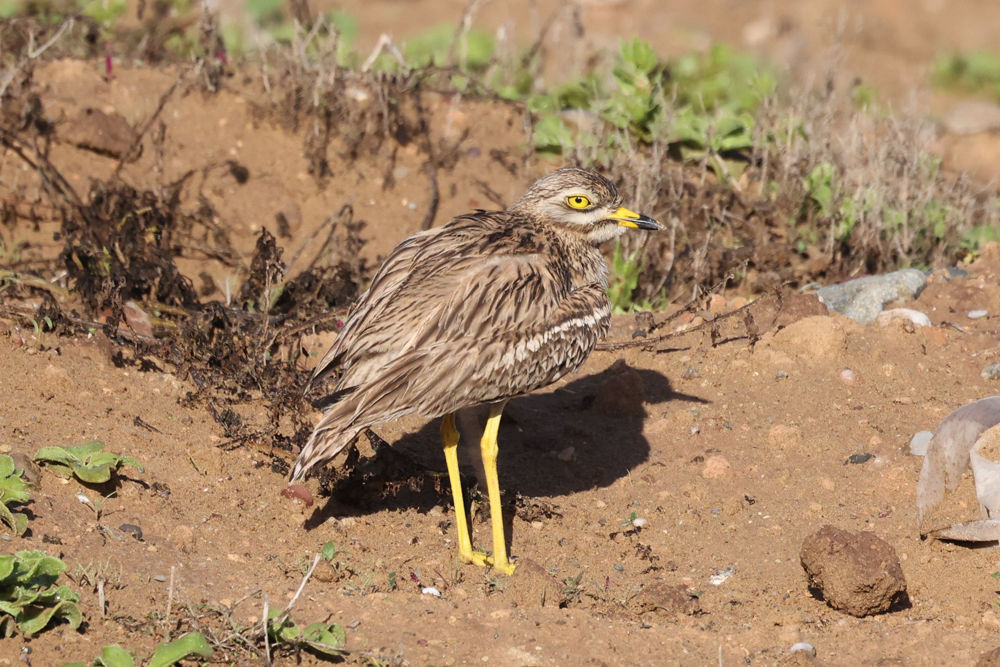
Eurasian Thick-knee along the Atlantic coast at Agadir
A long journey day through the deserts on the way to Ouarzazate allowed for a few quick birding stops. A great sighting was a small flock of Black-bellied Sandgrouse in some arid fields. We noted our first Black Wheatears in the mountains and White-crowned Wheatears in the deserts. A fortuitous find in a rocky canyon along a curvy road was Barbary Partridge; we also notched our first Desert Lark in the scenic canyon where Oleander is native. On the outskirts of Ouarzazate we birded some scrubby areas and found our first and best sighting of the beautiful Blue-cheeked Bee-eater perched in Tamarisk with several migrant warblers hopping around in the trees below.
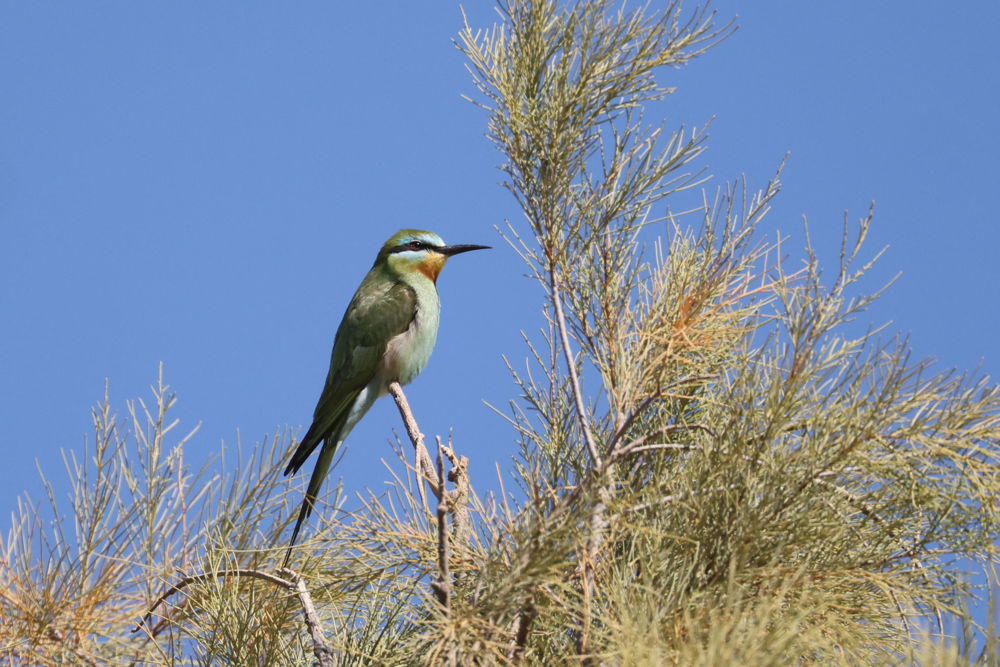
Blue-cheeked Bee-eaters were returning for the spring
Common Chiffchaff, Willow Warbler, and Western Bonelli’s Warblers were all on a break from their northward migrations to Europe for the summer. We also noted hundreds of White Storks soaring up in kettles winging their way north, too. Nearby at the Mansour Reservoir we found an acacia full of fledgling Great Gray Shrikes with their parents making food deliveries as we watched. Perhaps the most exciting sighting was the Moroccan Spiny-tailed Lizard Ossama spotted on the roadside while we were distracted by birds! This gorgeous large lizard was peachy-orange with a fat spiky tail. In the evening, we drove out into the rocky desert near Boumalne Dades; a special outing would soon unfold for us. Hasam, a local guide, first walked us to a large flat rock that he delicately lifted, revealing the best reptile of the trip, a Saharan Horned Viper! Then he led us into the wadi with 100-foot-tall cliffs hemming us in. In a little notch, a somnolent Pharoah Eagle-Owl watched over her wide-eyed chicks tucked into an alcove in the red sandstone cliffs—another trip highlight.
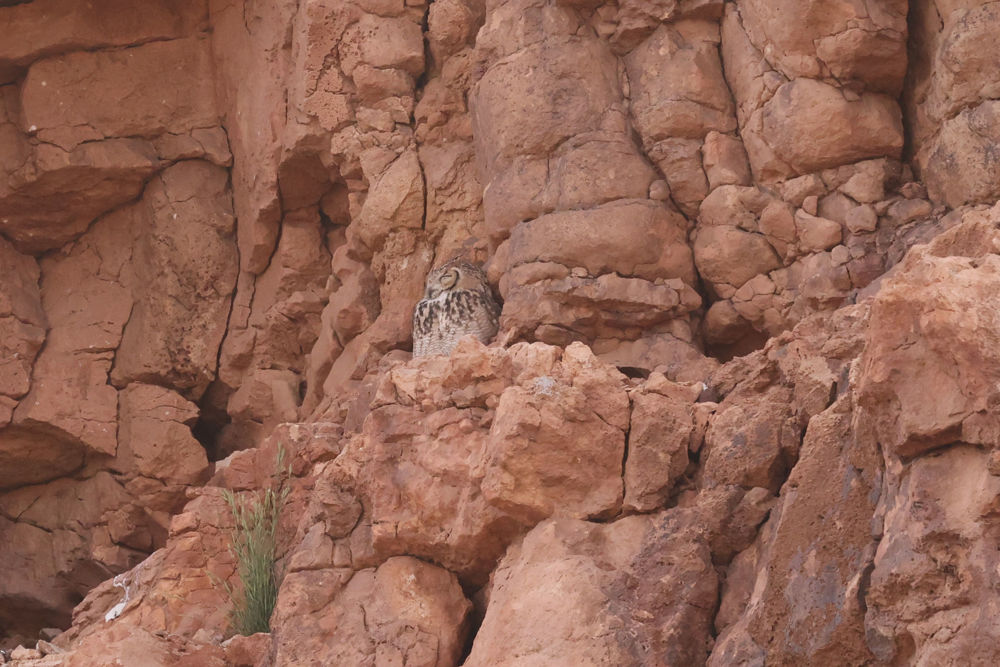
Pharaoh Eagle-Owl "watching" over her chicks, hidden to the left
Trumpeter Finches and a male (Maghreb) Mourning Wheatear topped the evening as we meandered back to the van. A cooperative Desert Wheatear and our only Red-rumped Wheatear only added to the magic of a six wheatear evening. Our drive to the hotel was interrupted by a couple of Short-toed Snake-Eagles and an (Atlas) Long-legged Buzzard adding to the greatness.
Another magical day started early when we found Thick-billed Larks. After watching their comings and goings for half an hour, we realized they were tending a nest in the desert—saving us a visit to the dump, a reliable spot for the lark. Our next birding destination was the famous Tagdilt Track for larks and the elusive Cream-colored Courser. A great deal of scanning revealed our first Temminck’s Larks, some Desert Wheatears, Greater Short-toed Larks, Great Gray Shrikes, and our first Greater Hoopoe-Larks. Further searches revealed some distant Black-bellied Sandgrouse in the heatwaves. Finally, among goats and shimmer, Carl pried a Cream-colored Courser from the desert. We pursued them with our scopes and cameras, but the heatwaves prevented us from getting good photos; however, the scope views were good enough to see the smooth plumage and soft blue-gray crown. After lunch and a little break we ventured into Dades Gorge, past the monkeys’ fingers. Red earth and the kasbahs along the river tell of generations of people who have relied on the water wealth of the Dades River. Hairpin after hairpin wound us to the top of the gorge and a good spot to search for Tristram’s Warbler. Before we had even sized up the scenery around us, Santi had a Tristram’s Warbler that put on a great show for us. Further down the road we walked through the shadows of the soaring red cliffs above us, finding a few Eurasian Crag-Martins zipping on the canyon winds. Another gorge the following morning produced another great sighting—a female Lanner Falcon sitting in her nest waiting for the male to produce some breakfast. Soon enough she was stretching and took flight. The male was there with a half-eaten rodent, possibly a Fat Sand Rat. She grabbed breakfast and quickly ate it down. Then there was much vocalization and they mated before the male flew off. I hope they have a successful spring raising falcons in the desert. A Long-legged Buzzard was also cruising the gorge, undoubtedly with a nest hidden nearby.
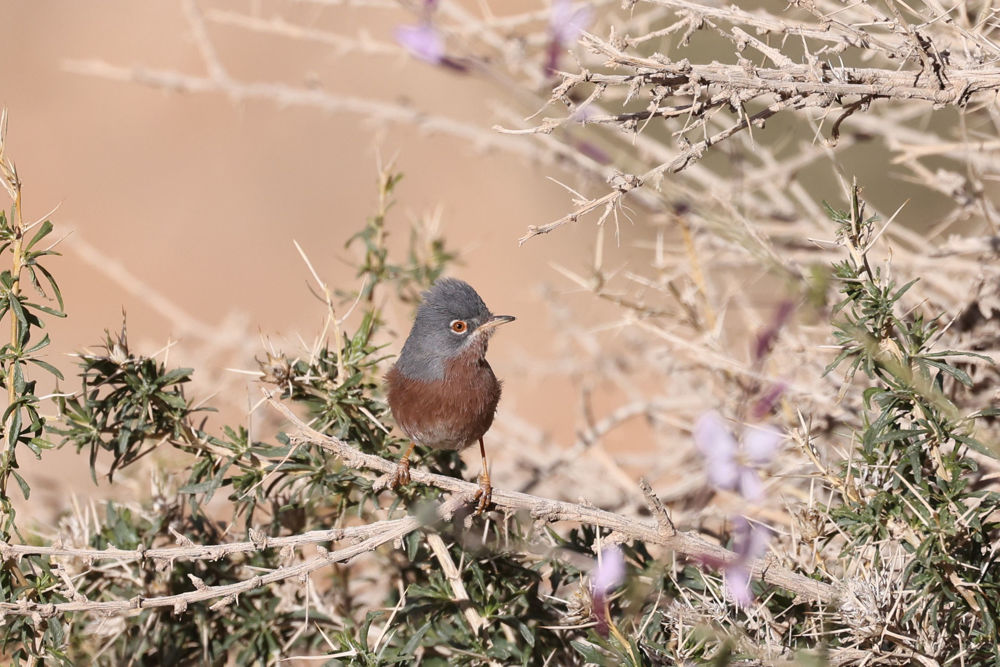
Tristram's Warbler - all photos © Brian Gibbons
Todra Gorge broke up our drive before lunch. A nice stream flowed through the gorge and attracted a few birds. The most unusual was a male Common Kingfisher! More expected were Gray Wagtails, Blue Rock-Thrush, and Crag-Martins. After these great sightings we continued on our journey to the edge of the Sahara Desert at Erg Chebbi. One promising wadi lured us to hike for Scrub Warbler in the desert. While we didn’t find the warbler, we found another Great Gray Shrike and a family party of Fulvous Chatterers, which was an exciting find in the desert. After another great lunch we walked again for Scrub Warbler. This time we found them, but they didn’t want to be seen, and we had a challenge getting good looks at this sneaky semi-terrestrial warbler. We arrived at our hotel just as sunset was painting the western sky with wonderful pastels and the dunes of Erg Chebbi loomed to our east.
The next morning we drove past the dunes en route to a watering hole that attracted hundreds of sandgrouse for our viewing pleasure. Spotted, Crowned, and a few Pin-tailed sandgrouse made coursing flights past us and landed in the desolate field in front of us. Even as the wind gathered and we experienced our first mini-sandstorm, the sandgrouse came and went. Next, we made a few walks into the desert, searching for the African Desert Warbler, allowing us to study the plants of the desert, track beetle paths, and follow rodent runs as they left footprints in the desert sands. We watched the captivating display flights of male Greater Hoopoe-Larks as they ascended, singing on their strikingly black-and-white wings only to dive straight back to earth with their wings closed after a short flight.
After not finding the Desert Warbler, we made a stop at the Desert Sparrow acacia, and a family group finally flew in; while the male was sneaky, we got great looks at the female and young and their extremely pale plumage. Overhead, a pair of Brown-necked Ravens soared on the desert winds. Another special sighting lay ahead; again, the local guides had a good bird lined up for us. After a quick stop at a guide’s house, he wasn’t home, which caused me a bit of a panic. But the drivers all knew the spot, and soon we were scoping up a female Egyptian Nightjar with the golden fuzz of a chick sticking out from under her right wing. Another great lunch in a cool Kasbah right at the edge of the dunes was also attended by House Sparrows that came and went as they pleased.
Our final stop of the evening was the recently filled oasis lake at Dayet Srij. Hundreds of Greater Flamingos, more than 100 Ruddy Shelducks, and dozens of Black-winged Stilts and Pied Avocets were calling this new oasis home. The shelducks and stilts already had young, taking advantage of the temporary wetland—it will be gone this summer. One of our most memorable walks into the desert followed the lake. We weren’t far in when a few of us saw a flash of movement out of the corner of our eyes. It was a large falcon, and it quickly dived into the brush, chasing prey. We quickly assessed it had caught its prey, allowing us to get great looks in the scope as it caught its breath, presumably after a long tail chase. After several minutes it started plucking and eating its quarry, which turned out to be an unlucky Spotted Sandgrouse. We weren’t the only ones that had seen the action. A Booted Eagle had probably seen the whole thing and quickly appeared overhead making half-hearted dives while circling the falcon and keeping an eye on us. It never went for the falcon, but if we hadn’t been right there, I think the falcon would have lost its lunch to the larger eagle. The sandgrouse would have been so large that there wouldn’t have been any way it could outrun the eagle. We were privileged to watch the whole thing play out before us, all the while missing the African Desert Warbler, which we would never find.
Through the afternoon the wind had gained strength, and by the time we got back to the hotel, right on the edge of the dunes, we were in a sandstorm. The sky turned gray, and the sun faded out long before it hit the horizon. Our final desert walk produced many tracks in the sand, perhaps even those of a Desert Warbler, but we never saw the little critter!
We returned to the Todra Gorge for lunch on Ossama’s recommendation and it paid off. The Barbary Goats high up on the cliff face entertained us and others for much of our lunch, but it was amazing how quickly they could scamper around a corner or over the ridge and disappear. We also had our first African Blue Tit sighting here, although not everyone saw it well; we would all get better looks in the High Atlas Mountains in the coming days.
Again, we broke up our drive at Ouarzazate at Dar Chamaa, a great little place to rest on journey days. On our way to Ait Benhaddou, we stopped for a migrant Osprey that seemed out of place on a power pole in the desert. We were also stopped by the police, and after some wrangling Ossama paid a little bribe and off we went to the World Heritage Site at Ait Benhaddou. We also had some amazing birding in the High Atlas Mountains at Ouakaimeden.
Thanks for traveling with VENT. I look forward to our next birding adventure, wherever in the world that might be.
-Brian Gibbons and Santi Villa
A complete list of the birds recorded on our trip can be found at: https://ebird.org/tripreport/
Description for the next departure of this tour.
Brian Gibbons' upcoming tour schedule.
ITINERARY:
|
12 March 2025 - Marrakech, Drive to Agadir, Souss River Estuary birding |
|
13 March 2025 - Massa River Bridge Sidi Ouassai, Aghbalu, Bald Ibis at Sidi Ouassai village, Souss Massa National Park |
|
14 March 2025 - North of Agadir, Amazighen Hotel coffee & warblers, Tamri Village, Timlalin Dunes, Cape Rhir, Ksima section Souss River after lunch |
|
15 March 2025 - Agadir to Ouarzarzate, Souss River Valley, Aguni N'fed, Bad Sahara Hotel in Tazenakht, Halouqpte view point, Ouarzazate |
|
16 March 2025 - Ouarzazate, reservoir Tizgi Lilan, Al Mansour Reservoir trash dump and lake, Panorama Restaurant Kelaat M'gouna, Ravines & wadis Imider |
|
17 March 2025 - Xaluca Dades Hotel, Ikniouen Road, Tagdilt Track, Dades Gorge |
|
18 March 2025 - Lanner Falcon Imidier village, Todra Gorge, Tinejdade lunch and scrub warbler sites - Road to Goulmima, Erfoud, Hotel Kasbah Tombutou |
|
19 March 2025 - Erg Chebbi dunes general area, Merzouga Lake wet for 1st time in 7 years aka Dajet Srij |
|
20 March 2025 - Merzouga Lake, African Desert Warbler walk, Rissani, Oued Ziz |
|
21 March 2025 - Final warbler walk at Haroum, Rissani, Moulay Ali Chariff, M'Cissi no coffee stop, Todra Gorge Annisa, Skoura rest stop, Ouarzarzate |
|
22 March 2025 - Ait Ben Haddou, Taskoutet, Dar Zara, Argan Tichka Restaurant, Oukaimeden Ski area, Aurocher Hotel |
|
23 March 2025 - Aurocher Hotel, Oukaimeden ski area, Ourika Valley with Karim's Annrar Ourika Lodge, Kasbah Tifirte road, Marrakech |
|
24 March 2025 - Marrakech area tour, Menara Park, Koutoubia Minaret, Souk Medersa Ben Youssef, |
|
24 March 2025 - Marrakech area tour, Menara Park, Koutoubia Minaret, Souk Medersa Ben Youssef, |

