

Difficulty
Himalayan Wilderness & Buddhist Kingdom
Bhutan
An immersive journey into the untouched forests and soaring peaks of Bhutan—where rare Himalayan birds, primeval landscapes, and a deeply rooted Buddhist culture converge. From subtropical lowlands to high mountain passes, this tour offers some of the finest birding in Asia in one of the world’s most intact natural kingdoms.
Tour Overview
Mar 26–Apr 12, 2027
Bhutan remains one of the last great sanctuaries of the Himalayas—a country where vast forests cloak the mountainsides, wildlife is protected by tradition as much as by law, and ancient monasteries cling to cliffs above river valleys. For the birder and naturalist, it represents the pinnacle of Himalayan exploration.
Our journey traverses a remarkable elevational gradient, beginning in the warm floodplains bordering the Brahmaputra and ascending through lush Sal forest, subtropical broadleaf woodland, and temperate rhododendron and magnolia forests before reaching alpine passes at 13,000 feet. Along this progression of habitats we search for some of the most coveted birds in Asia: Ward’s Trogon glowing in moss-draped forest; Rufous-necked Hornbill gliding over valleys; Satyr Tragopan and Himalayan Monal in high mountain glades; Fire-tailed Myzornis flashing through conifers; and the exquisite Beautiful Nuthatch. Bhutan’s cultural reverence for life results in birds that are often remarkably confiding, allowing intimate and unforgettable encounters.
The diversity extends beyond birds. Golden Langur move through forest canopies, Yellow-throated Marten patrol forest edges, and nocturnal searches may reveal Leopard Cat or Bhutan Giant Flying Squirrel. Across elevations we encounter flowering primulas, orchids, magnolias, and rhododendrons that lend the landscape both color and fragrance.
Equally compelling is Bhutan’s enduring Buddhist culture. Dzongs and monasteries overlook valleys alive with prayer flags and chanting monks. Hospitality is warm and genuine, and traditional architecture harmonizes beautifully with the surrounding wilderness. Birding days are complemented by cultural visits that provide insight into one of the most distinctive societies on earth.
This is not simply a birding tour—it is a full immersion into a mountain kingdom where nature and culture remain profoundly intertwined.
Ecosystems Experienced
Bhutan’s landscapes unfold along a dramatic elevational transect. Subtropical riverine plains and Sal forests give way to broadleaf evergreen forest, dense temperate woodland, and rhododendron-magnolia slopes before reaching high alpine meadows and windswept passes. Moss-draped valleys, bamboo thickets, and snow-encrusted ridges create a mosaic of habitats supporting exceptional Himalayan biodiversity.
Expected Climate
Temperature
Conditions vary widely with elevation. Lowland valleys can be warm to hot during the day, while mid-elevation forests are mild and comfortable. High passes and mountain camps are cool, especially mornings and evenings, with cold nights possible at altitude.
Rainfall
Rain is possible, particularly in forested and montane zones, where passing showers or overcast conditions may occur. Lower elevations tend to be drier, though weather can shift quickly in the mountains.
Seasons
Spring and early summer are prime seasons for Himalayan birding. Forests are vibrant, rhododendrons bloom, and birds are active and vocal. Snow lingers only at the highest elevations, and wildlife is widely visible across the elevational gradient, making this an ideal time to experience Bhutan’s extraordinary ecological range.
Previous Field Reports
Key Species
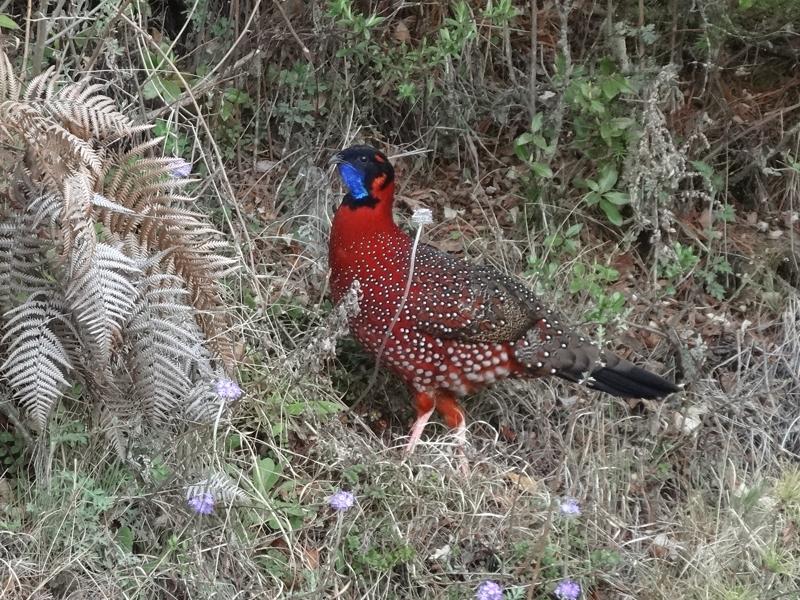
Satyr Tragopan
Blood Pheasant
Great Hornbill
Rufous-capped Babbler
Yellow-billed Blue-Magpie
Black-browed Tit
Leader
+ Local Leader
Max Breckenridge
Primary Leader
Australian bird guide and conservationist with deep field experience, known for his sharp ear, adventurous spirit, and dedication to bird protection.
Read MoreItinerary
Click here to download the 2027 itinerary PDF
Day 1
Depart and begin the journey across the Pacific, adjusting to new time zones along the way.
Day 2
Cross the International Dateline en route to Bangkok.
Arrive in Bangkok and settle into the Hyatt Bangkok Suvarnabhumi.
Gather for a welcome dinner and tour briefing.
Day 3
Fly from Bangkok to Paro, enjoying the dramatic approach into the valley.
Begin birding in the Paro Valley, including along the Paro Chu, with opportunities for species such as Ibisbill.
Day 4
Travel from Paro to Chele La Pass (14,000 feet), searching for pheasants and other Himalayan specialties.
Enjoy field breakfast and lunch amid spectacular mountain scenery.
Continue to the Haa Valley for the night.
Day 5
Follow the Ha Chu south and cross Tergola Pass (13,000 feet).
Explore rhododendron forests rich in laughingthrushes, rosefinches, fulvettas, sunbirds, and other Himalayan birds.
Descend to our camp on the Amo Chu at Gakiling.
Day 6
Spend a full day exploring the forests and river habitats around the Amo Chu and Gakiling.
Overnight at our riverside camp.
Day 7
Bird back through Tergola Pass.
Continue through blue pine forests and villages to Thimphu.
Overnight in Thimphu.
Day 8
Bird the Cheri Valley section of Jigme Dorji National Park.
Search for woodpeckers, parrotbills, warblers, laughingthrushes, and Satyr Tragopan.
Optional sightseeing, shopping, or additional birding in Thimphu.
Day 9
Morning birding at Dochula and the Royal Botanical Gardens.
Continue to Punakha.
Visit Punakha Dzong at the confluence of the Mo Chu and Po Chu with an expert cultural guide.
Day 10
Bird along the Puna Tsang Chu, looking for waterfowl and passage migrants.
Follow the river south through dramatic valleys in search of White-bellied Heron.
Overnight in Damphu.
Day 11
Explore the broadleaf forests of Darachu.
Descend to the Brahmaputra floodplains near the Indian border.
Continue to Gelephu for the night.
Day 12
Travel north from Gelephu with birding stops through forested hills.
Arrive at Tingtibi and our lodge beside the Mangde Chu.
Day 13
Explore the forests and bamboo habitat around Tingtibi and Goling.
Search for regional specialties and White-bellied Heron.
Additional birding or relaxation at the lodge.
Day 14
Travel from Tingtibi to Trongsa with birding along the old Zhemgang Road and the Mangde Chu Valley.
Overnight in Trongsa.
Day 15
Bird the forests around Trongsa.
Pass Trongsa Dzong en route to Pelela and the Phobjika Valley.
Overnight overlooking the Phobjika Valley.
Day 16
Final morning birding at Pelela for pheasants, finches, and other Himalayan species.
Return via Dochula to Paro.
Farewell dinner and final evening in Bhutan.
Day 17
Transfer to Paro Airport for the flight to Bangkok.
Day rooms at the Hyatt Bangkok Suvarnabhumi are available before onward departures.
What’s Included
Accommodations & Dining
Settle into comfortable accommodations with modern amenities. Enjoy freshly prepared meals that highlight local flavors and international favorites, with consideration for any dietary needs.
Guided Services & Gratuities
Experience each destination with the help of Leaders who share history, culture, and wildlife insights. Gratuities for crew and local guides are included, ensuring seamless service without extra concerns; tipping for your Leaders is discretionary and not included.
Active Essentials
Every tour includes the core elements that make our field experiences possible so you can stay engaged with a range of activities. All outings include the necessary equipment and full safety support, making it easy to join at your own pace.
Transportation & Logistics
We coordinate every transfer, from airport pickup to port boarding. Whether traveling by bus, boat, or charter, our team ensures smooth connections and stress-free travel.
FAQs
Similar Trips
Loading calendar...